Exploring Funky Patterns - Watercolor Folk Art for Creative Projects
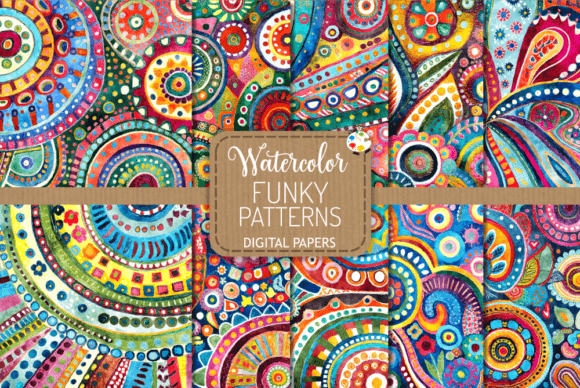
In the landscape of digital design resources, finding a texture that balances organic fluidity with bold structural integrity can be challenging. Funky Patterns - Watercolor Folk Art represents a specific niche where the unpredictability of hand-painted media meets the precision required for modern surface design. This collection distinguishes itself through a unique combination of shabby chic aesthetics and vibrant color palettes, offering a distinct alternative to rigid vector graphics or purely photographic textures.
For designers, crafters, and sublimation artists evaluating their toolkit, understanding the specific characteristics of this style is crucial. The set comprises 12 unique images that serve as a foundation for various applications, ranging from textile printing to digital scrapbooking. Unlike standard seamless patterns found in many asset libraries, these designs embrace irregularity, providing a more authentic, handcrafted feel that resonates with current trends favoring imperfection and human touch.
The Distinctive Nature of Shabby Chic Watercolor Styles
What sets Funky Patterns - Watercolor Folk Art apart from generic watercolor assets is its deliberate approach to transparency and edge definition. In traditional digital painting, achieving a "natural" watercolor effect often requires complex layering and masking. This collection addresses that by incorporating varying degrees of transparency within the painted areas directly into the PNG files. This technical detail allows the underlying background to interact with the pattern, mimicking the way real pigment settles on paper.
The aesthetic falls squarely into the folk art category but is reimagined with a "funky" twist. This implies a departure from strict symmetry or traditional cultural motifs. Instead, the patterns feature geometric shapes, tribal influences, and patchwork elements that are softened by the watercolor medium. The result is a visual language that feels both structured and free-flowing. For professionals creating fashion prints or surface designs, this duality offers a versatile base that avoids looking overly corporate or sterile.
When comparing this style to other digital papers, one must consider the resolution and file format. Each image in the set is provided at 4096 by 4096 pixels with a 150dpi resolution. While high-resolution vector graphics offer infinite scalability without quality loss, they often lack the textural depth of raster-based watercolor effects. Conversely, low-resolution clip art fails when scaled up for large-format sublimation. The 150dpi specification here suggests an optimal use case for medium-to-large print projects where extreme close-up viewing is not the primary concern, yet high visual fidelity is required.
Evaluating Format Choices: Seamless vs. Non-Seamless Designs
A critical decision point for any designer is whether to choose seamless patterns or non-seamless imagery. Funky Patterns - Watercolor Folk Art explicitly falls into the latter category. This distinction significantly alters how the assets should be utilized in a workflow.
Seamless patterns are designed to tile infinitely without visible breaks. They are the industry standard for fabric repeats, wallpaper, and wrapping paper where a continuous field of color is necessary. However, they can sometimes appear repetitive or artificial if the tiling algorithm is not perfect. Non-seamless images, like those in this collection, function more like individual artworks or focal points. They are ideal for:
- Single-use prints: T-shirts, tote bags, or mugs where the entire surface is covered by one image rather than a repeating motif.
- Collage work: Digital scrapbooking or mixed-media compositions where the edges of the pattern are meant to be visible against a contrasting background.
- Textile accents: Creating borders, patches, or specific design blocks within a larger garment rather than covering the whole fabric.
Choosing this type of asset over a seamless alternative requires a shift in mindset. Instead of focusing on tiling algorithms, the designer focuses on composition and placement. The tradeoff is that you cannot simply drag and drop the image to fill a canvas without considering margins and negative space. However, the benefit is a more dynamic, less predictable final product that stands out in a market saturated with uniform repeating textures.
Comparative Analysis: Vector vs. Raster Watercolor
When researching options for similar visual styles, designers often encounter two main categories: vector-based watercolor simulations and true raster watercolor paintings. Funky Patterns - Watercolor Folk Art belongs to the raster category. Understanding the difference helps in selecting the right tool for the job.
Vector watercolor effects are created using mathematical paths that mimic brush strokes. They are crisp, scalable, and generally smaller in file size. However, they often lack the subtle bleeding of colors and the granular texture of actual paint. They can look too clean or "digital" for certain artistic applications.
In contrast, the raster nature of these 12 unique images preserves the natural artifacts of watercolor painting. The transparency variations mentioned earlier create depth that vectors struggle to replicate convincingly. If your project involves sublimation printing on textiles, the raster format is often preferred because it captures the nuanced gradients that make the fabric feel softer and more integrated with the design. The downside is that scaling a raster image beyond its original dimensions (4096x4096) will result in pixelation, whereas vectors would remain sharp.
Strategic Applications and Use Cases
To determine if this resource fits your specific needs, it is helpful to visualize practical scenarios where these patterns excel. The intersection of "geometric," "tribal," and "textile" themes makes this collection particularly robust for fashion and home decor industries.
Sublimation Printing: The 150dpi resolution combined with the high pixel count makes these images suitable for sublimation transfers. The transparent PNG versions allow for easy placement over different garment colors without the need for manual background removal. The "shabby chic" style adds a vintage appeal that is currently popular in bohemian and eclectic fashion lines.
Surface Design and Textiles: For interior designers, these patterns can serve as inspiration for upholstery or drapery. The non-seamless nature means they work well as statement panels or accent pillows rather than full-room coverage. The mix of tribal and patchwork elements provides a narrative quality that flat geometric designs often lack.
Digital Craft and Scrapbooking: Hobbyists utilizing digital scrapbooking software will find the transparency features invaluable. Layering these watercolor patterns over textured backgrounds creates a sense of history and wear, enhancing the storytelling aspect of the layouts. The 4096-pixel width ensures that even when printed on large photo books or canvases, the details remain clear.
Decision Factors: When to Choose This Style
Selecting the right digital asset involves weighing several factors, including budget, intended output, and desired aesthetic. Funky Patterns - Watercolor Folk Art is an excellent choice when authenticity and texture are prioritized over geometric perfection. It is particularly suited for projects that aim to evoke emotion, nostalgia, or a handmade quality.
However, there are limitations to consider. If your project requires a perfectly repeating grid for a massive roll of wallpaper, this non-seamless set will require significant editing to stitch together, which may not yield the same results as a dedicated seamless tile. Similarly, if your workflow relies heavily on vector manipulation for rapid prototyping, these raster files will limit your ability to resize elements individually without losing quality.
The inclusion of both JPG and Transparent PNG formats adds versatility. The JPGs provide a quick reference or a ready-to-print option for solid backgrounds, while the PNGs offer the flexibility needed for complex compositing. This dual-format delivery is a strong indicator of a resource designed for professional utility rather than casual browsing.
Conclusion on Resource Selection
In the broader context of digital design resources, Funky Patterns - Watercolor Folk Art occupies a valuable space between fine art and commercial utility. It bridges the gap between the chaotic beauty of traditional painting and the organized demands of digital production. By offering 12 unique, high-resolution images with realistic transparency, it empowers creators to produce work that feels personal and crafted.
Ultimately, the decision to incorporate this style depends on the specific goals of the project. For those seeking to add a touch of organic charm to geometric structures, or to introduce a vintage watercolor vibe to modern folk art themes, this collection offers a compelling solution. It serves as a reminder that in an era of hyper-digital precision, there remains a profound value in embracing the imperfections of the human hand.